


Global Perspectives on Data Protection and Privacy: Spotlight on the Global South
In a world increasingly driven by data, the protection of personal information and privacy has emerged as a cornerstone of responsible AI development. As AI applications continue to grow, questions around data protection and privacy in regions like the Global South become ever more pressing.
By Sally Kuria

In a world increasingly driven by data, the protection of personal information and privacy has emerged as a cornerstone of responsible AI development. As AI applications continue to grow, questions around data protection and privacy in regions like the Global South become ever more pressing.
The Global Index on Responsible AI (GIRAI) 2024, a flagship project of the Global Center on AI Governance, offers vital insights into the state of data protection across diverse regions, highlighting both the progress made and the urgent challenges that persist.
With a focus on the Global South, this analysis reveals a complex landscape where non-state actors often lead initiatives in the absence of robust government frameworks, pointing to the essential steps needed to bridge global divides in data governance.
Privacy and Data Protection in the Age of AI
As digital transformation accelerates, privacy has expanded to encompass information privacy—the right of individuals to control their personal data. Defined in the UNESCO Principles on Personal Data Protection and Privacy, personal data includes any information that can identify an individual either directly or indirectly. In the AI era, data protection laws have become critical to ensuring the right to privacy. They serve as regulatory mechanisms that guide the collection, processing, and storing of personal data, requiring accountability when data is misused.
Despite international frameworks, the reality is that AI systems frequently depend on vast datasets, often involving sensitive information. Without robust legal frameworks, this data collection can infringe on individuals’ privacy. Consequently, standards like the OECD AI Principles and UNESCO’s Recommendations on the Ethics of AI call for lawful data processing and protections that align with responsible AI practices globally.
Key Findings
After evaluation of data, the GIRAI ranks data protection and privacy third out of 19 thematic areas globally, highlighting its significance.
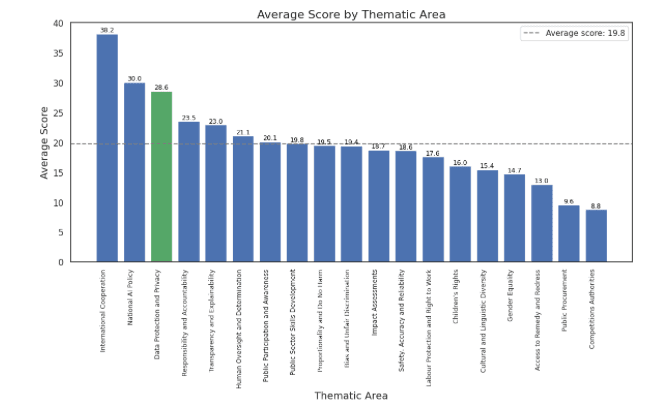
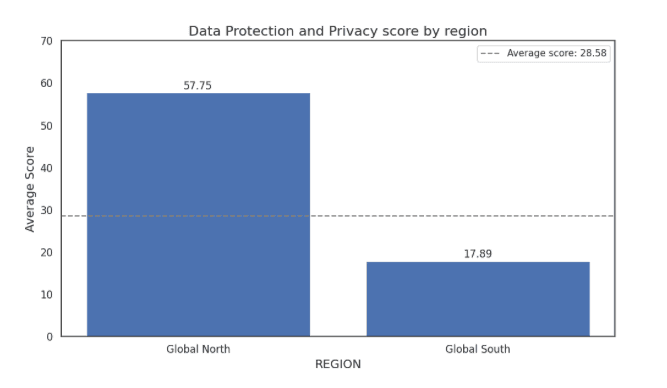
However, countries in the Global South score nearly ten points below the world average, with the Global North showing much stronger performance. This disparity underscores a critical need for policy and regulatory focus in developing regions, where effective data protection frameworks often lag behind.
Regionally, Asia leads the Global South in data protection and privacy scores, followed by Latin America and the Caribbean, and then Africa. Countries like South Africa, the United Arab Emirates, and Uruguay emerge as regional leaders, demonstrating higher compliance and established frameworks. These countries exhibit strong government engagement through comprehensive frameworks and actions, complemented by robust non-governmental initiatives across various sectors, including civil society, academia and the private sector.
The Divide in Government Frameworks and Actions
Government actions in the Global South primarily focus on developing draft frameworks, signaling an intent to establish future legal protections. For countries currently lacking comprehensive frameworks, prioritizing draft policies is often the most effective step towards building a foundation for data protection.
Non-State Actors: An Essential Force
Non-state actors—primarily academia, civil society, and the private sector—play a crucial role in the Global South’s progress on data protection. Unlike government frameworks, which vary widely by region, non-state actor initiatives are more uniformly distributed across the Global South. Academia leads these efforts globally, contributing to 38.3% of non-state actor activities, while civil society and the private sector account for 31.2% and 30.5%, respectively.
In the Global South, the private sector’s contribution is slightly higher than in the Global North, highlighting its role in driving awareness and advocacy in the absence of government-led frameworks. Research, analysis, and public awareness initiatives dominate, with conferences and workshops also prominent, particularly in Latin America and the Caribbean.
Regional Insights: Africa, Asia, and Latin America & the Caribbean
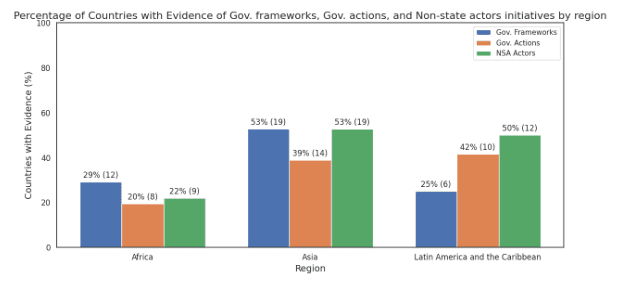
In Africa, data protection and privacy remain underdeveloped, with low scores and limited evidence across the three pillars evaluated by the GIRAI. While 29% of the African countries evaluated by the GIRAI have established government frameworks, and 20% show evidence of government actions, non-state actors play a slightly more significant role, with initiatives present in 22% of countries. South Africa stands out with a notably high score for the region, but the majority of African countries lack government commitment through frameworks or actions, or contributions from academia, civil society, and the private sector.
Asia demonstrates a balanced approach. This region benefits from substantial contributions by non-state actors, and 53% of countries have established government frameworks, which contribute to its high score in data protection and privacy. The UAE emerges as a leader with robust, enforceable frameworks, while non-state actors across Asia play a pivotal role in advancing privacy initiatives, underscoring the region’s collaborative efforts in fostering effective governance.
In Latin America and the Caribbean, non-state actors play a significant role, representing the most active category at 50%. Government actions are evident in 42% of countries in the region, reflecting some level of government engagement. Uruguay leads the region with comprehensive data protection measures. Academia, along with the private sector, is heavily involved, contributing to conferences, advocacy campaigns, and research. However, formal government frameworks are less common, leading to an uneven landscape.
Closing the Gap
The GIRAI 2024 reveals that while there is a growing commitment to data protection and privacy across the Global South, significant disparities persist. Strengthening government frameworks, diversifying government actions, and supporting non-state actor initiatives will be essential to achieving equitable and effective data protection globally. As AI continues to permeate various sectors, these steps are critical to safeguarding citizens’ rights, particularly in regions where governance structures are still evolving.
To dive deeper into the Global Index on Responsible AI and explore detailed scores, supporting evidence, and insights visit our dedicated webpage https://www.global-index.ai/
This article has been written by Sally Kuria, Head of Communications at the Global Center on AI Governance based on a Data Brief prepared by Ana Florido, Methods Lead, Global Index On Responsible AI