


Labour Protection and Right to Work in the Age of AI
The 2024 Global Index on Responsible AI (GIRAI) zeroed down on Labour protection and right to work as a key indicator of human rights as it continually impacts access to employment. This analysis looks at how different regions compare in terms of dignified work opportunities in the age of AI as well as the leading role non-state actors play ensuring people's right to work is safeguarded.
By Daphine Nkunda
The Global Index provides both global and regional trends on the practices and actions both government and non state actors are taking to achieve responsible AI. Through the Human Rights and AI dimension, countries are assessed on measures taken to uphold and protect the rights of especially marginalised groups. The increasing deployment of Artificial Intelligence (AI) across various sectors continues to fuel the widespread sentiment that "AI aims to replace workers". While new roles undoubtedly emerge, the skilling gap throughout the AI development lifecycle poses significant risks, leaving many workers vulnerable to impacts that are often "invisible". Governments play a crucial role in protecting workers' rights, ensuring that technological progress doesn't compromise labor protections or exacerbate inequalities.
The 2024 Global Index on Responsible AI (GIRAI) zeroed down on Labour protection and right to work as a key indicator of human rights as it continually impacts access to employment. This analysis looks at how different regions compare in terms of dignified work opportunities in the age of AI as well as the leading role non-state actors play ensuring people's right to work is safeguarded.
Access to decent work and labour protections
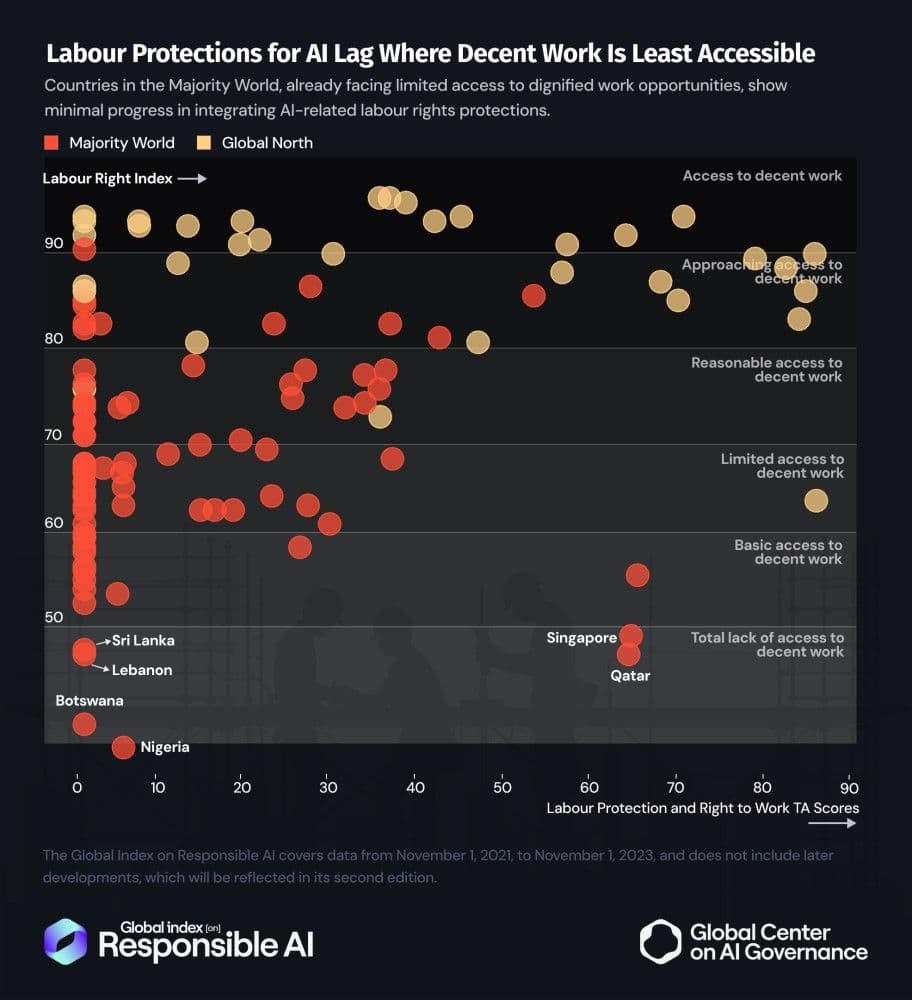
The chart reveals a troubling intersection: countries with the least access to decent work are also making the least progress in protecting labour rights in the age of AI. This is particularly stark in the Majority World, where most countries cluster in the lower tiers of the labour rights index and report little to no evidence of AI-related labour protections.
Nigeria, home to over 200 million people and nearly 15 percent of Africa’s population, falls into the lowest category of labour rights access and records one of the weakest scores on AI labour protections. Botswana shows a similar pattern, reinforcing a broader trend of systemic vulnerability.
The uneven distribution across regions highlights a global gap. Where AI labour rights are emerging, they are doing so in contexts already more economically advantaged.
Global inequalities in safeguarding workers' rights in the age of AI
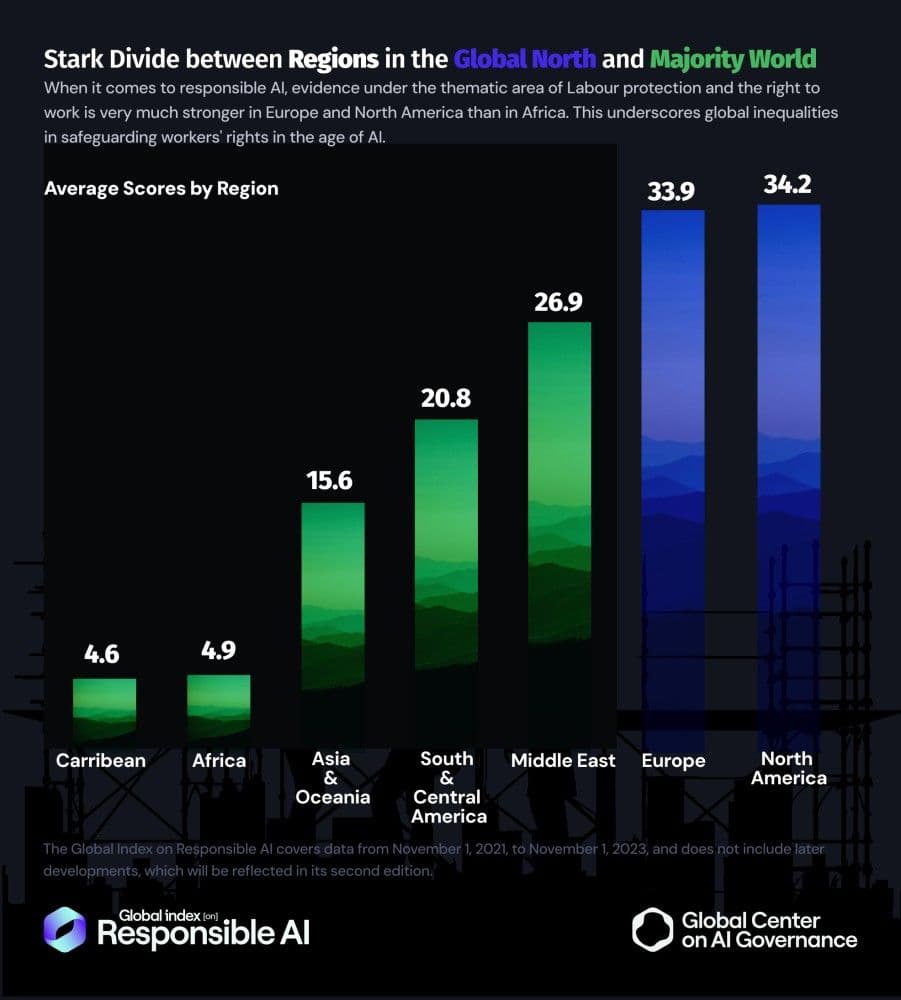
There is a stark divide in how regions are addressing labour rights in the context of AI. Europe and North America report the highest average scores, 33.9 and 34.2 respectively, on labour protection and the right to work, showing significantly more documented evidence of responsible practices. In contrast, regions in the Majority World, including Africa (4.87), the Caribbean (4.6), and Asia and Oceania (15.6), report much lower scores.
This gap reflects broader patterns of global inequality in AI governance. While regions in the Global North are advancing frameworks to protect workers in digital economies, countries in the Majority World appear to face critical capacity and infrastructure gaps.
The role of non-state actors in responsible labour practices
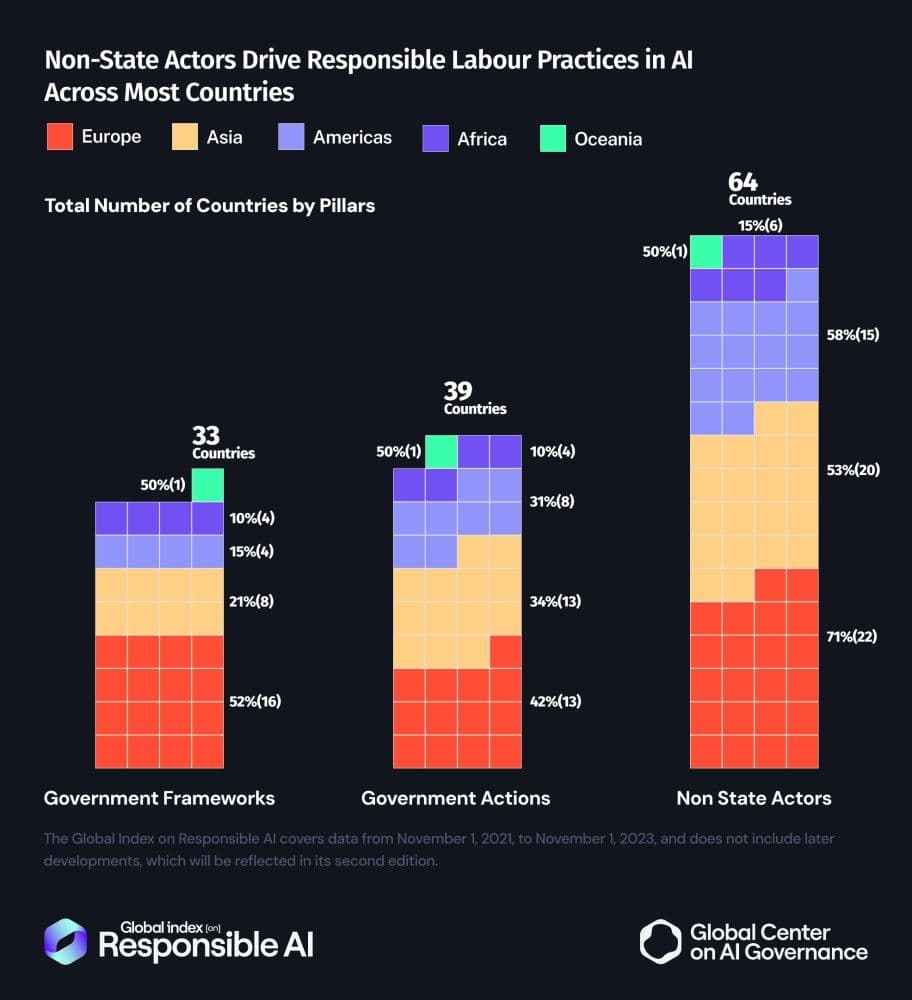
Among the three pillars tracked by GIRAI—non-state actors, government frameworks and government actions, non-state actors consistently show the highest level of engagement across all regions. Evidence of their involvement was found in 64 countries, nearly twice as many as those linked to government actions (39) or frameworks (33).
This pattern is consistent across most regions. In Asia, for instance, 53% of surveyed countries showed non-state actor engagement, compared to just 21% with government frameworks. In the Americas, 58% of countries reported civil society or private sector involvement over three times the rate of government-led efforts (15%). Even in Africa, where overall engagement was lower, non-state actors were active in 15% of countries, compared to 10% for government initiatives.
Europe stands out with the strongest participation: over 70% of surveyed countries show non-state actor involvement, with relatively balanced activity across all three pillars.
These findings underscore the vital role of non-state actors (including civil society groups, trade unions, and the private sector) play in shaping labour protections within AI governance. At the same time, they reveal uneven regional commitments and emphasize the need for more proactive government leadership, particularly in underrepresented areas.
Government frameworks addressing responsible AI practices
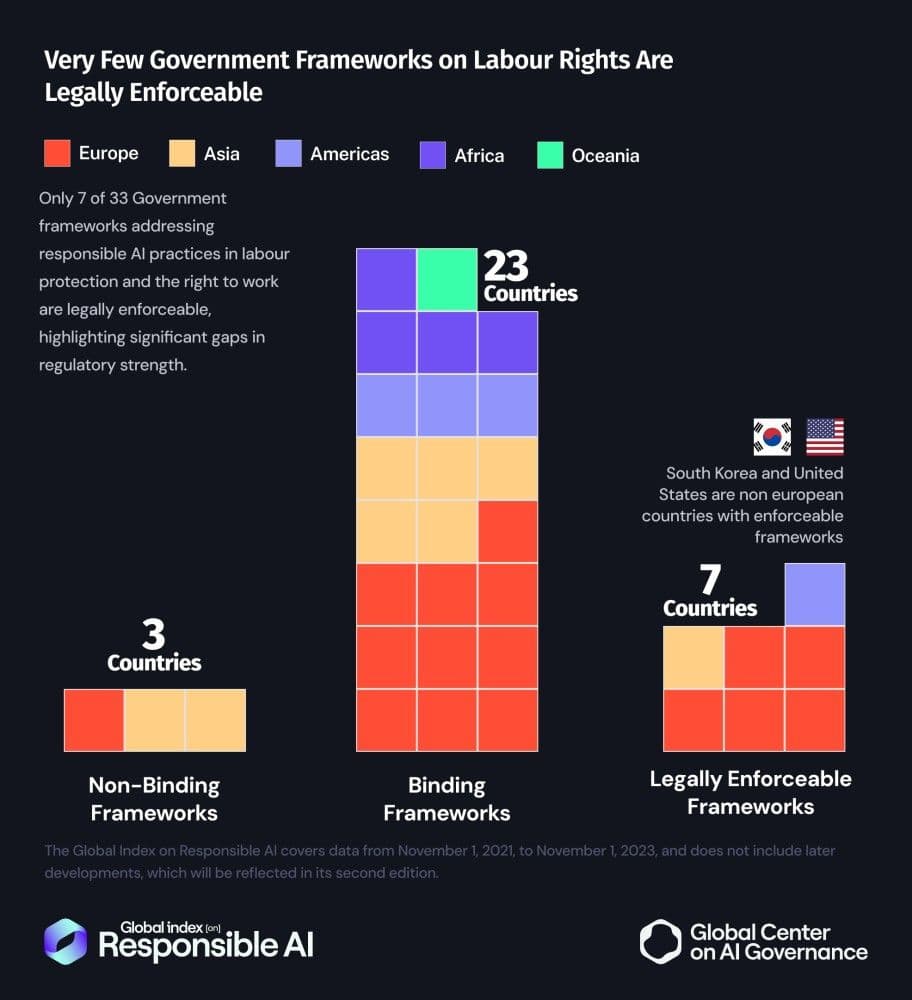
The majority of government frameworks addressing responsible AI practices in labour protection and the right to work lack legal enforceability. Out of 33 identified frameworks globally, only 7 are legally enforceable. Most fall under the category of binding (but not legally enforceable) commitments, and a smaller number are entirely non-binding.
Regionally, this regulatory gap is especially stark. Europe accounts for the vast majority of enforceable frameworks, with five of the seven. The remaining two are found in Asia (South Korea) and the Americas (United States), leaving Africa and Oceania without a single legally enforceable framework.
Labour protection and right to work as a human right
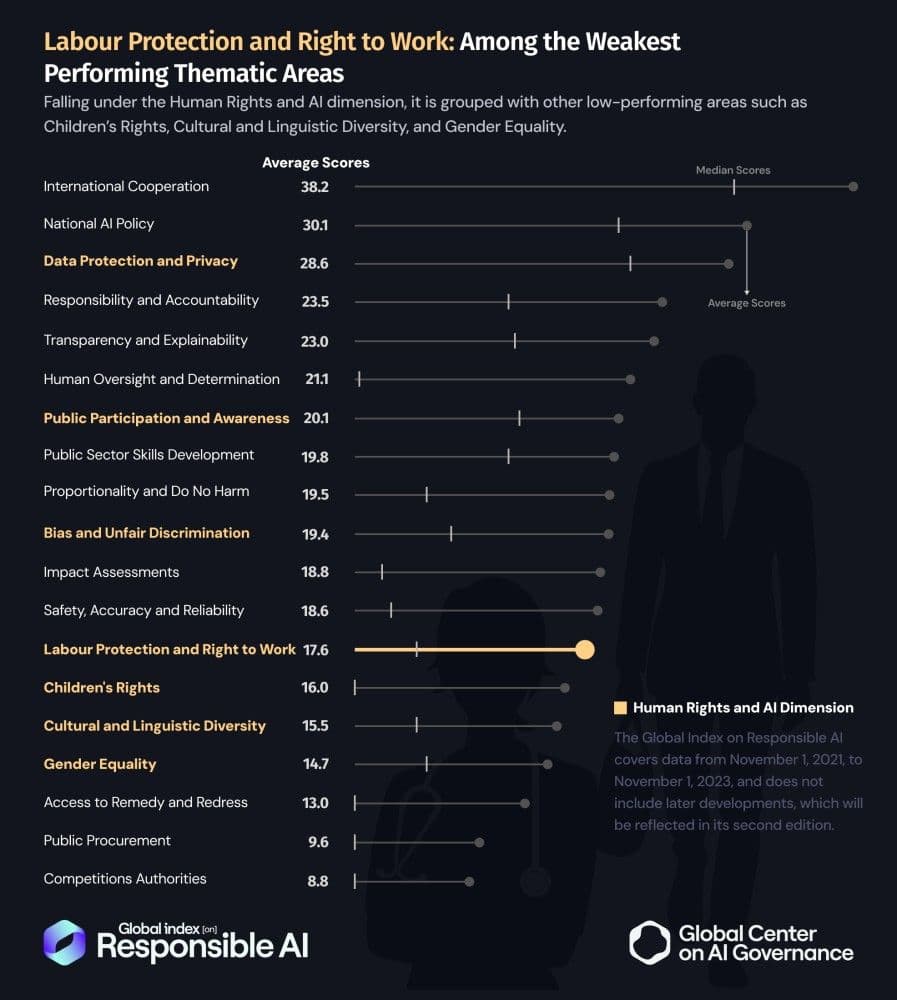
Despite growing conversations about responsible AI, labour protection and the right to work remain among the least prioritized areas. With an average score of just 17.6, this thematic area ranks 13th out of 19 falling behind more prominent themes such as international cooperation, data protection, and national AI policy. It sits alongside other low-performing areas within the human rights and AI dimension, including children’s rights, cultural and linguistic diversity, and gender equality.
This gap raises concerns about how current AI governance frameworks are addressing the rights and protections of workers. As AI systems continue to shape hiring, monitoring, and workplace decision-making, the lack of clear safeguards for labour rights signals a troubling oversight in global efforts to ensure fairness and accountability.
Actions non-state actors take to ensure Labour Rights
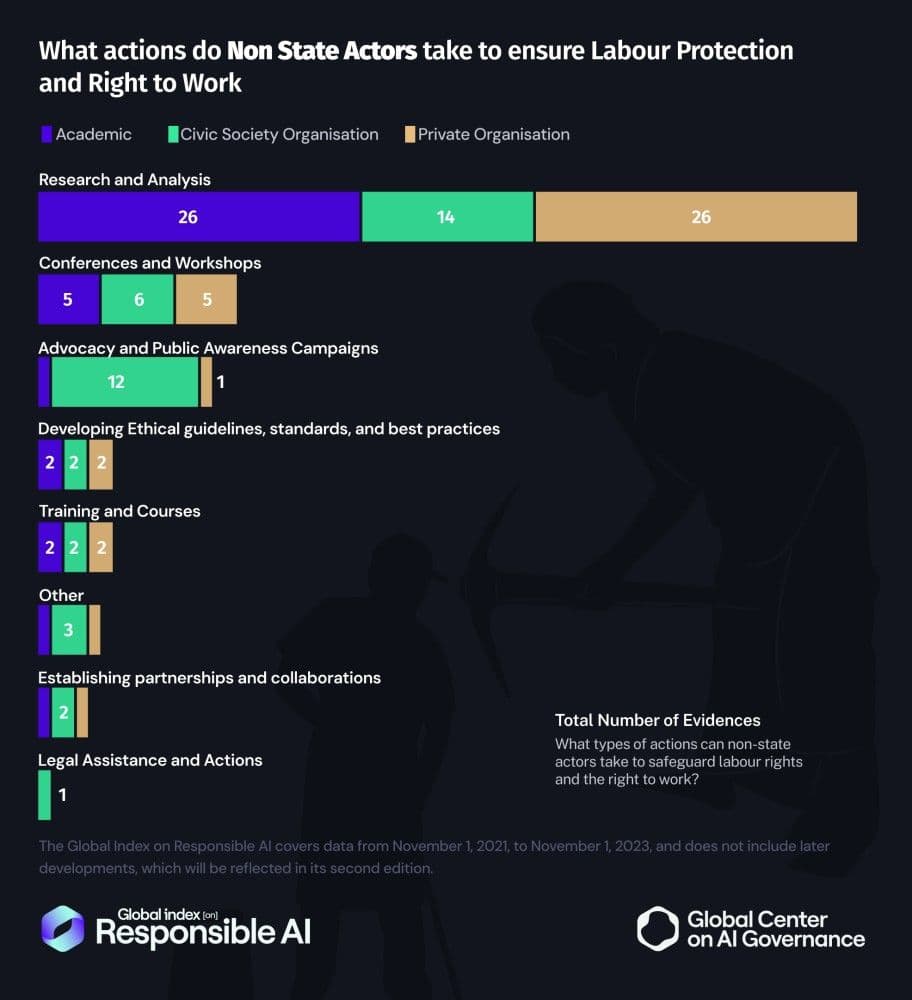
When it comes to safeguarding labour rights and the right to work in the age of AI, non-state actors such as academia, civil society, and the private sector are most active in producing research and analysis. This type of engagement is the most common across all three sectors, with academic institutions and private organizations each contributing 26 initiatives, and civil society contributing 14.
Other forms of engagement are far less common. Conferences, workshops, and advocacy campaigns follow at a distance, with civil society organizations leading public advocacy efforts. Notably, civil society is the only sector involved in legal action, although such activity remains limited.
Relatedly, this report “Navigating Labor Protections in the Era of AI: Insights from the Global South” by the African Observatory on Responsible AI gives Global South insights on navigating labour protection in the age of AI. It examines how countries in the region are balancing technological advancement with human-centered approaches to protect workers’ rights.
Credits: The data brief and visualizations presented here were created by Jayeola Gbenga , winner of the 2024 GIRAI Data Visualization Challenge.