


Safety, Accuracy, and Reliability of AI in Africa: A Critical Analysis
In this article, we will focus on Safety, Accuracy, and Reliability, one of the core thematic areas evaluated by the Global Index on Responsible AI. This thematic area is critical to ensuring trustworthy and reliable AI systems, and the analysis will specifically examine the performance of the African region, which is home to 41 countries included in the Index.
By Sally Kuria
The Global Index on Responsible AI (GIRAI), launched in 2024 and based on data collected between November 2021 to November 2023, is the first comprehensive tool designed to set globally relevant benchmarks for responsible AI. As a flagship project by the Global Center on AI Governance, it evaluates countries across 19 thematic areas, assessing their efforts to implement ethical, equitable, and trustworthy AI practices. These thematic areas range from data protection and privacy to fairness, inclusion, and sustainability, providing a holistic view of responsible AI development.
In this article, we will focus on Safety, Accuracy, and Reliability, one of the core thematic areas evaluated by the Global Index on Responsible AI. This thematic area is critical to ensuring trustworthy and reliable AI systems, and the analysis will specifically examine the performance of the African region, which is home to 41 countries included in the Index.
The Importance of Safety, Accuracy and Reliability in AI
As AI systems become more integrated into critical sectors like healthcare, finance, and public services, ensuring Safety, Accuracy, and Reliability is essential to protect individuals, build trust, and prevent failures.
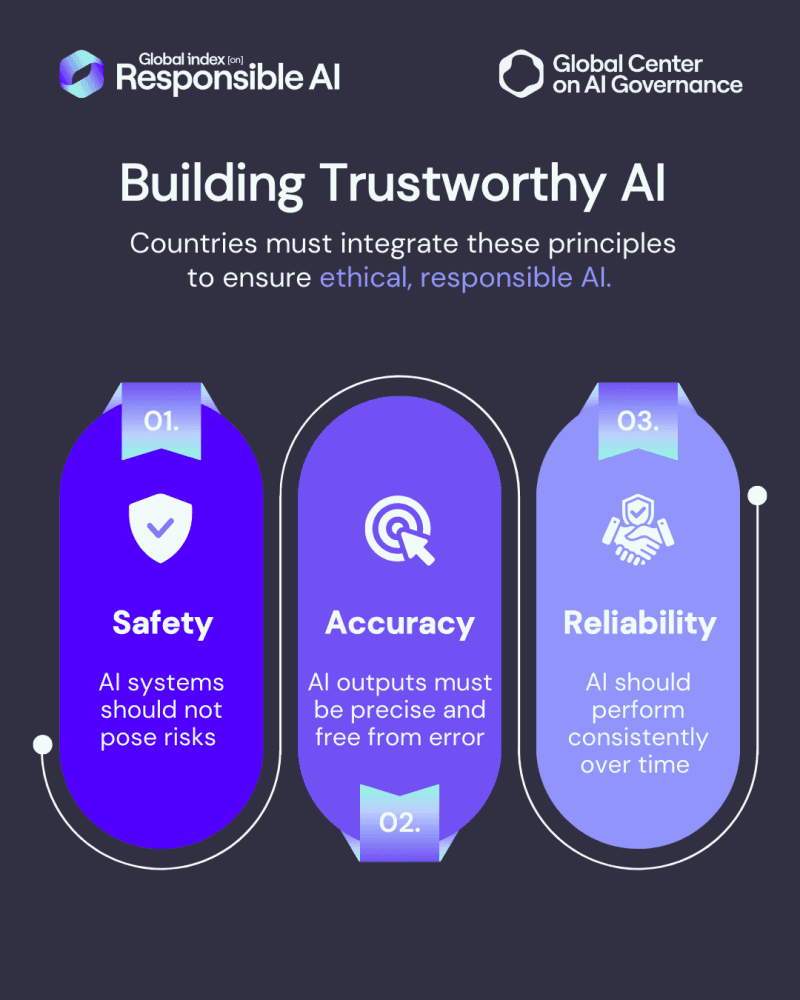
- Safety: AI systems must avoid causing harm. They should be robust, secure, and designed to prevent accidents or misjudgments, especially in high-stakes areas like autonomous vehicles or healthcare.
- Accuracy:AI models need to make correct predictions and decisions based on their training data. Inaccurate systems can perpetuate biases and lead to harmful or inefficient outcomes.
- Reliability:AI systems must perform consistently over time and across different conditions. They should be resilient to changes in data or the environment, ensuring dependable outputs.
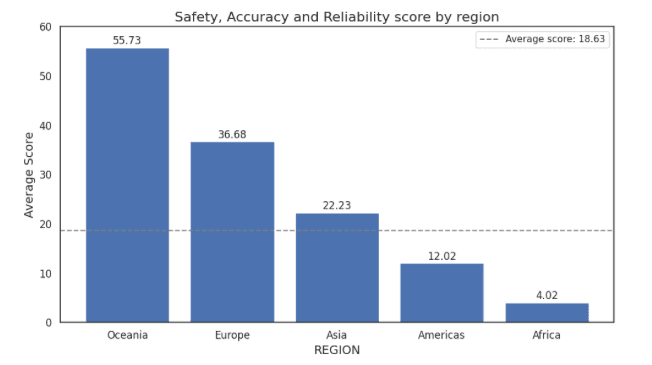
The Global Index on Responsible AI reveals a concerning reality for Africa in the thematic area of Safety, Accuracy, and Reliability. Out of the five regions analyzed globally, Africa has the lowest average score, with an overall score of just 4.02 out of 100. This figure is significantly below the global average of 18.6 and highlights the region’s critical challenges in advancing responsible AI governance in this domain.
While Africa shows promising growth in digital innovation and AI adoption, these findings demonstrate that many countries have yet to implement robust safeguards to ensure AI systems are safe, accurate, and reliable. Out of the 41 African countries included in the Global Index, only 11 provided evidence of any activities related to AI safety, accuracy, and reliability. This leaves 30 countries with no evidence, a clear sign of the region’s gaps in this essential area of AI governance.
Here are other key highlights from Africa’s performance:
- Kenya leads with a score of 44.4, showing strong evidence across all pillars (Government Frameworks, Government Actions and Non-State Actors). Ghana (28.9), Morocco (28.6), and Rwanda (27.1) also show commitment but fall short of global standards.
- Only Kenya and Rwanda have binding frameworks, while Ghana,Kenya, and Morocco show some government actions, highlighting a need for stronger leadership.
- In 24%of countries, civil society, academia, and the private sector drive progress, with notable efforts in South Africa,Tunisia, and Morocco, emphasizing the importance of collaboration.
Key Findings for Africa
The Global Index on Responsible AI paints a mixed picture for Africa in the Safety, Accuracy, and Reliability thematic area. While the region faces significant challenges, a few countries show promising signs of progress. The analysis, structured around the three key pillars of Government Frameworks, Government Actions, and Non-State Actor (NSA) Involvement, reveals the following key findings:
Government Frameworks: Limited but Emerging
Out of the 41 African countries assessed, only two—Kenya and Rwanda—have frameworks addressing AI safety, accuracy, and reliability. These frameworks are essential for establishing regulatory standards that can guide the safe deployment of AI systems. Kenya’s National Digital Master Plan (2022–2032) and Rwanda’s National AI Policy are examples of forward-thinking initiatives that aim to ensure responsible AI use.
However, the fact that 39 countries lack any such frameworks highlights a significant governance gap, leaving much of the continent without formal regulations to ensure AI is implemented safely and accurately.
Government Actions: Limited Involvement
Government-led initiatives are scarce in Africa. Only three countries—Ghana,Kenya, and Morocco—provided evidence of government actions aimed at addressing AI safety, accuracy, and reliability. These actions include programs, draft frameworks, and events aimed at raising awareness of AI governance.
Despite these efforts, the limited number of countries involved shows that most African governments have yet to take concrete steps in advancing AI safety. More proactive government involvement is needed to establish a solid foundation for AI governance across the continent.
Non-State Actors: A Vital Role
Non-state actors (NSAs), including civil society organizations, academia, and the private sector, play a crucial role in advancing AI safety, accuracy, and reliability in Africa. Evidence shows that 24%of the countries assessed have active NSA involvement in this thematic area.
Academia leads the charge, contributing to 50% of NSA initiatives, while the private sector accounts for 33.3%, and civil society represents 16.7%. This distribution indicates that educational institutions are at the forefront of AI safety discussions in Africa, often driving research, dialogue, and knowledge-sharing on responsible AI practices.
Countries like Tunisia,South Africa and Morocco demonstrate strong NSA participation, highlighting how collaborative, multi-stakeholder approaches can help bridge gaps where government involvement is lacking.
Call to Action: The Need for Collaboration
The findings from the Global Index on Responsible AI highlight a critical need for collaborative action across Africa to advance the safety, accuracy, and reliability of AI systems. While Non-State Actors (NSA) like academia and the private sector have shown significant initiative, the limited government involvement underscores the need for a more comprehensive, multi-stakeholder approach to AI governance.
- Government leadership is essential: Governments must establish frameworks to set AI safety standards. Kenya and Rwanda offer examples of leadership that other nations should follow.
- Strengthening Public-Private partnerships: Greater collaboration between governments, the private sector, and academia is crucial. The private sector can share expertise, especially in sectors like healthcare and finance.
- Empowering Non-State Actors (NSAs): NSAs, including civil society and academia, are vital in filling governance gaps. Governments should work with them to develop technically sound and inclusive policies.
- Building capacity across the continent: Many African countries lack the technical capacity to govern AI. Partnerships with global and regional bodies, like the African Union, can help build this capacity through training and knowledge-sharing.
- Regional cooperation for AI governance: African countries need a consistent framework for AI governance, supported by regional cooperation and the African Union’s Continental AI Strategy.
- Investing in research and innovation: More investment in AI research is needed, focusing on solutions to African challenges. AI safety research is crucial to developing reliable and inclusive AI systems.
Conclusion: A Path Forward
To ensure AI technologies benefit everyone, Africa must prioritize collaboration, capacity-building, and research. By working together, governments, private sectors, and civil society can close the gap with other regions and lead the way in responsible AI development.